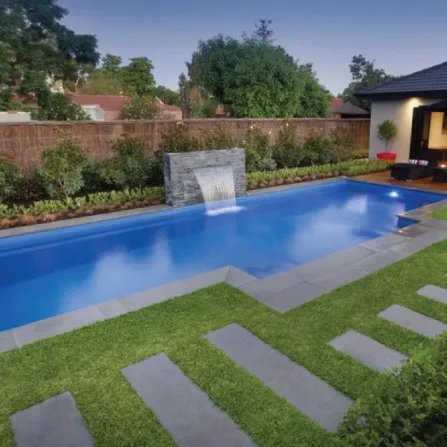
A shell moulded in a factory, cured under controlled conditions, and craned into a prepared hole. When your lot has the access for it, the calendar is measured in weeks rather than months.

The shell arrives finished. Excavation and base preparation happen first, then a crane sets the shell, plumbing gets connected, and backfill goes in slowly and correctly around the sides. Decking follows. Most of the drama is compressed into a single day, and it is a good day to be home for.
The surface is the part people underrate. Gel coat is nonporous, so algae has a much harder time getting a foothold than it does on plaster. Over years that usually means less chemistry, less brushing, and no resurfacing cycle to budget for.
This is the one that quietly rules out a lot of Houston properties, and it is worth answering before anybody falls in love with a model.
Newer master planned neighbourhoods with wide side yards, an open approach, no low canopy and no overhead lines crossing the route. The crane has room to set up and swing.
Established suburbs where the side yard is tight, a fence panel has to come out, or a mature tree needs careful trimming. Often workable, sometimes at real added cost.
Inside the Loop especially: narrow lots, alley-only access, heavy canopy and utility lines overhead. These are gunite properties whether anyone likes it or not.
Fiberglass compresses the schedule, but Houston clay does not care how quickly the shell arrived. Base preparation, backfill placed in proper lifts, and a plan for hydrostatic pressure matter just as much here as they do on a gunite build. Speed comes from the manufacturing, not from skipping steps on your lot.
When the lot fights back, a shell built in place is the only thing that bends around it.
The long version, written around what Houston clay actually does to a pool shell.
Gel coat is easier to keep clean, not self-cleaning. Here is what upkeep looks like.